Published February 14, 2024
Welcome to Silicon Desert: How Biden helped boost an Arizona boomtown

Welcome to Silicon Desert: How Biden helped boost an Arizona boomtown
Computer-chip manufacturers are building giant factories in Phoenix, helping draw more blue voters to this vital swing county

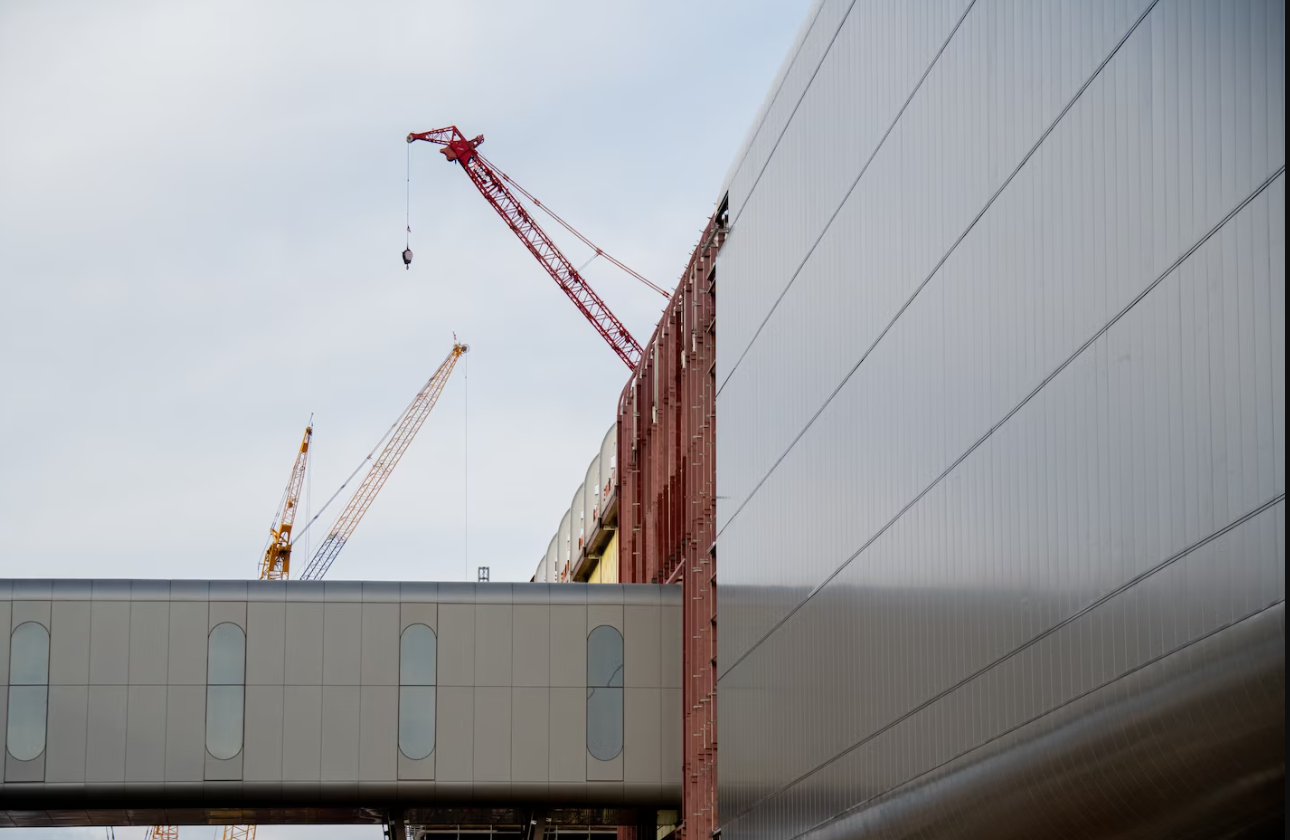
Construction at the Taiwan Semiconductor Manufacturing Co. facility in Phoenix. The company is investing about $40 billion in computer chip manufacturing plants, thanks in part to the passage of the Chips and Science Act of 2022. (Caitlin O’Hara for The Washington Post)
MARICOPA COUNTY, Ariz.. — It took 170 flatbed trucks to haul one of the world’s biggest cranes — the height of two Statues of Liberty — to the outskirts of Phoenix to start building a $20 billion computer-chip factory. On the other side of town, an even bigger chip-manufacturing project is rising from the desert, requiring 12,000 construction workers and $40 billion of investment.
Phoenix is a boom town, thanks in part to President Biden. The promise of federal subsidies from the Biden-backed Chips and Science Act of 2022 has sparked some of the biggest investment projects in the nation’s history, transforming Maricopa County into one of the world’s most important manufacturing sites for the tiny components that power all modern electronics.
Whether the investments will benefit Biden’s presidential campaign in this vital swing county is unclear. But the projects are creating thousands of high-tech jobs that will draw more professionals who tend to vote blue, analysts say. Maricopa, the nation’s fourth most populous county, is already purple, having flipped from Trump to Biden in the 2020 election.
Obstacles remain before the factories are up and running. The Biden administration has not yet awarded any funding to the projects, though announcements are expected in a few weeks. The semiconductor companies are also facing a shortage of construction and technical workers, causing one of the manufacturers to delay its timetable and import more technicians from Taiwan. But local business leaders, politicians and labor unions say the investment is helping turbocharge Maricopa County’s already strong economy, which is far outpacing the nation’s as a whole.
Maricopa County is growing much faster than the U.S. as a whole
Change from a year earlier in gross domestic product

Source: U.S. Bureau of Economic Analysis
“The Chips Act is a game changer for Phoenix for at least a generation,” Phoenix Mayor Kate Gallego said in an interview.
The Chips Act won bipartisan support in Congress as U.S. fears mounted that the nation had ceded too much semiconductor manufacturing to Asia. Computer chips are the brains that run everything from fighter jets and smartphones to autos, making them essential to national and economic security.
In Maricopa County, Taiwan Semiconductor Manufacturing Co. (TSMC) announced a $12 billion investment in 2020, under former president Trump, saying that the project would require “support” from the federal government. TSMC added a second factory after the Chips Act passed, more than tripling its investment.
California-based Intel, which has been producing chips in Maricopa County for more than 40 years, announced a significant expansion in March 2021, calling federal funding crucial.
The investments are helping transform Phoenix, bringing dozens of additional companies to the area to supply the mammoth factories. The change is most visible around the TSMC site in the county’s relatively undeveloped northwest corner, where warehouses, malls and housing developments are filling in the desert landscape.
Phoenix was already enjoying strong growth before the semiconductor projects arrived, after a push to diversify its economy away from real estate following the 2008 financial crash. But economists say the massive chip investment is amplifying the boom. Maricopa County’s GDP grew by 4.1% in 2022 against 1.9% for the United States as a whole, and its unemployment rate for most of the past several years has been below the national average.
The county has also experienced faster wage and population growth than the rest of the country. The expansion of the tech industry has helped push Maricopa County in a more blue direction, said Paul Bentz, a pollster at HighGround, a public-affairs and lobbying shop in Phoenix. The shift is already well underway east of Phoenix, in the area including Intel’s long-standing operations — accelerated by the local Republican Party’s embrace of far-right “MAGA candidates,” Bentz said.

Workers in the lobby of the TSMC facility in Phoenix. (Caitlin O’Hara for The Washington Post)

Workers unload a shipment of office chairs at the TSMC facility in Phoenix. (Caitlin O’Hara for The Washington Post)
The pace of Phoenix’s transformation has caught many by surprise. Soon after chip engineer Mino Morgese bought land west of Phoenix and started building a house three years ago, he accepted a job with TSMC and left the country for 18 months of training in Taiwan. When he returned to Maricopa County he hardly recognized his neighborhood.
Houses and schools were springing up in place of farms and desert landscape. A luxury shopping mall, a Home Depot and a string of new restaurants were opening. And logistics and chemicals suppliers were moving in to work with the twin factories TSMC is building. One of the biggest newcomers, Amkor, recently bought 55 acres of land for a $2 billion factory that will package and test TSMC’s chips for Apple and other customers.
“It was like, is this the same place?” Morgese recalls asking himself when he returned from Taiwan.
His workday begins around 7 a.m., when he heads to the loading dock to oversee the delivery of the world’s most expensive manufacturing equipment. If the temperature-controlled trucks don’t arrive and unload in the right order, it can create a logjam of sensitive machinery from Singapore, the Netherlands and parts beyond. “It comes down to, the crew that unloads the tool needs to go home,” Morgese said. “And now I have half a million dollars of material sitting outside.”
TSMC has delayed the start of manufacturing chips at the first factory from this year to 2025, citing a lack of skilled workers needed to install equipment. In July, Chairman Mark Liu said the company was sending more technicians from Taiwan to train local workers.
That sparked an angry response from construction labor unions, which said foreign workers were taking American jobs that were subsidized by taxpayer money. Tensions cooled in December after TSMC and the unions reached an agreement on workforce cooperation.
TSMC has a white-collar workforce of 2,200 full-time employees at the site, just under half of whom are from Taiwan. That includes engineers, technicians, finance, HR and management, a group expected to grow to 4,500 over time. The company says its U.S. hiring efforts include a new apprenticeship program and recruiting at university job fairs.
A senior Biden administration official said the government doesn’t see the presence of Taiwanese workers as “necessarily problematic.”
“This company is one of the best in the world at doing this, and this training that they’re providing is essential to setting up this facility,” the official said, speaking on the condition of anonymity to discuss the commercially sensitive project. “But the point here is that over the long term, the work will be done by American employees.”
Arizona State University is trying to help meet soaring demand for engineers by dramatically expanding its engineering program, which has grown by about a third, to 32,000 students, since the chip investments were announced. It is also setting up two new schools to focus on advanced manufacturing and integrated engineering, the latter of which will be located near the TSMC site, university president Michael Crow said in an interview.
“We’re rising to the occasion,” Crow said. “You don’t snap your fingers and all of a sudden change your engineering workforce pipeline.”
Intel employees have fanned out at local community colleges to train new technicians. Jeffrey Davis is one of a dozen Intel engineers leading an entry-level course that teaches students how to fix equipment while wearing the head-to-toe jumpsuits required on the pristine factory floors.
“There’s so much semiconductor coming to the Valley that there’s not enough people,” Davis said during a classroom break at Chandler-Gilbert Community College. “I’ve seen a lot of jobs starting to hit the market” for entry-level technicians, he added, with starting pay from $24 to $32 per hour.
One of his students, Stephanie Lombard, said she didn’t know what a semiconductor was before she started the class. But after getting laid off from a job at Verizon, she decided to give it a go. Other students had backgrounds in IT, property management and restaurants. German Rios, a former computer technician, said he joined the class after driving past the giant TSMC site and wondering what the buildings were.
Construction workers from around the country have been piling into Phoenix to build the factories, and local union halls are stepping up their recruitment. The local ironworkers shop is planning to build an additional training center to accommodate more apprentices, who undergo four years of classroom and on-the-job training in building steel structures, typically at Intel or TSMC. The group has 250 apprentices, up from 25 a few years ago, instructor Aaron McDonald said.

Apprentices take a class in Phoenix. (Caitlin O’Hara for The Washington Post)

Welding demonstrations hang on a peg board inside the Sheet Metal, Air, Rail, and Transportation Workers’ Local 359 Homer D. Dukes Sheet Metal Training Center in Phoenix. (Caitlin O’Hara for The Washington Post)
At a nearby union hall for sheet-metal workers, a dozen apprentices learned about computer-aided design before returning to their jobs at the chip plants, where they are installing miles of exhaust ducts. Parrish Boggs, 31, a third-year apprentice, said he’d heard of the Chips Act and the role it played in attracting the factory investments, but otherwise doesn’t pay much attention to politics. He didn’t vote in the last presidential election and probably won’t this year, he said.
“I just never had a positive interaction with politics,” he said. Boggs said he feels “very secure” about his financial future given all the work pouring in for sheet-metal workers, who earn $44.32 an hour and a pension once they complete their apprenticeship.