Published August 27, 2023
Cactus League 2023 economic impact numbers surge in Arizona

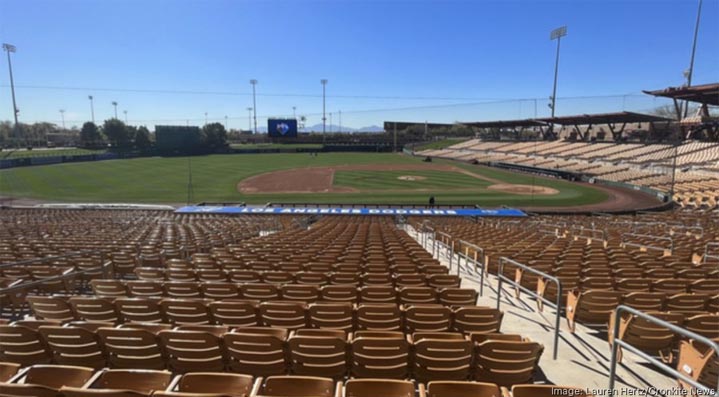
Cactus League 2023 economic impact numbers surge in Arizonaa

The 2023 Cactus League spring training for Major League Baseball generated $418.5 million toward Arizona’s gross domestic product and created $710.2 million in overall economic impact, according to a study released Friday by the Seidman Research Institute at Arizona State University’s W.P. Carey School of Business.
The 2023 Cactus League season was the first in several years that was not impacted by Covid-19 or a labor dispute.
The ASU study found that spending by Cactus League visitors this past spring created 5,893 annual jobs paying $271.9 million in salaries. Spring training also directly generated $28.4 million in taxes for the state of Arizona and $8.2 million for local governments.
The 2023 Cactus League consisted of hundreds of games played across 10 ballparks in the Phoenix area in February and March. A total of 1,565,182 fans attended those games, and the average attendance of 7,221 marked a 34% increase from 2022, exceeding expectations from local officials.
“The best thing about the Cactus League and what sets it apart from Super Bowls and NCAA championships and other major sporting events is that we are lucky to be host for one half of the country's spring training games right here every single year and we continue to show time and time again why we are the best place to host major sporting events," said Arizona Gov. Katie Hobbs. “There is nowhere else in the country where you can cheer on your favorite sport team one day and see one of the world's seven natural wonders.”
The ASU study showed that six out of every 10 attendees at a Cactus League game was from out of state, meaning a boost for the Valley’s and state’s tourism industry.
When conducting its surveys of more than 3,000 out-of-state visitors who attended Cactus League games, ASU found that hundreds traveled outside of the Valley to visit other parts of Arizona while here for baseball games. The majority of those took trips up to either northern Arizona or north central Arizona.
What to do with these numbers
Chris Calcaterra, the president of the Cactus League, said on Friday that the report shows the Cactus League is "an annual economic powerhouse," but it takes more than just the games being played here to keep that engine going.
“We can never take spring training for granted. To ensure the vitality of the spring training industry in Arizona, we must maintain and keep up facilities to meet the ever-changing demands. That requires investment. But as you can see today, that investment pays big dividends for the entire state.”
Calcaterra and Cactus League Executive Director Bridget Binsbacher both said that its their jobs now to take this report out to the different stakeholders around the Valley and the industry to make sure the league is supported through action and funding.
"Who doesn't love spring training baseball," Binsbacher said. "But when you hear about the community engagement piece, the jobs we create, the revenue streams – this is tremendous for our state. I'm out there telling that story all the time."
Besides regular upkeep on the 10 parks, which are mostly owned by municipalities and get grants on a regular basis from the Arizona Sports and Tourism Authority, Calcaterra said there appears to be demand for more social areas – like bars and patios at these ballparks. He said there are talks of changing traditional seating areas to group areas. Calcaterra said group business and sales were up in the 2023 season and he expects that to continue into 2024.
Compared to previous years
That $710.2 million total economic impact is up more than 10% from 2018, the previous year the economic impact was calculated when there wasn’t a season impacted by Covid-19. In 2018, spring training generated $644.2 million in total output. Adjusted for inflation, that figure is $779.2 million in 2023 dollars.
Anthony Evans, the senior researcher at the Seidman Research Institute at ASU, said that the total state GDP contribution in 2023 is about 4% from 2018. But he said that in 2018 there were 231 games, compared to the 216 in 2023. With fewer games, the total attendance in 2023 was down more than 11% compared to 2018.
Still, he said with the pandemic, inflation and several other factors, the $418.5 million boost to the state's GDP is positive.
“We estimate that out-of-state visitors alone directly spent around $345 million on lodging, in bars and restaurants, on retail and in-state transit, and on other local forms of entertainment," Evans said. "That’s a major infusion of new dollars into our local economy.”
Evans also pointed out that his study is quite conservative and only looks at spending from out-of-state visitors. It doesn't take into account money spent from people who live in the Valley or other parts of Arizona.