Published May 18, 2023
Arizona Coyotes' future cloudy after voters reject proposed arena project, according to early returns

 Source: Phoenix Business Journal | Ron Davis
Nervous energy turned into a near-deafening silence.
The Arizona Coyotes hoped to party into the late hours on Tuesday night celebrating the victory of a new full-time arena and entertainment district in Tempe. Instead, voters rejected three propositions that would allow them to proceed with the $2.3 billion project and the party quickly fizzled out.
The Coyotes hosted an election party for supporters of the team and the proposal along with a few Tempe city officials at Four Peaks Wilson, which opened its doors an hour before the results came in. Guests ate, drank, and chatted about when the results would come in, expressing uncertainty about the outcome.
Around 8 p.m., the broadcast on the bar's televisions of the NBA playoff matchup between the Denver Nuggets and Los Angeles Lakers at Four Peaks Wilson was flipped to the election results. With eyes squinting to make out "Yes" or "No" as the choice came on the screen, the chatter quickly halted, aside from a few expressions of disbelief.
"That's a gut punch."
"Now what?"
"What a bummer."
With the reality of the $2.3 billion entertainment district and new arena fading away, the televisions turned back into the closing minutes of the Nuggets and Lakers game.
Coyotes CEO: 'Very disappointed'
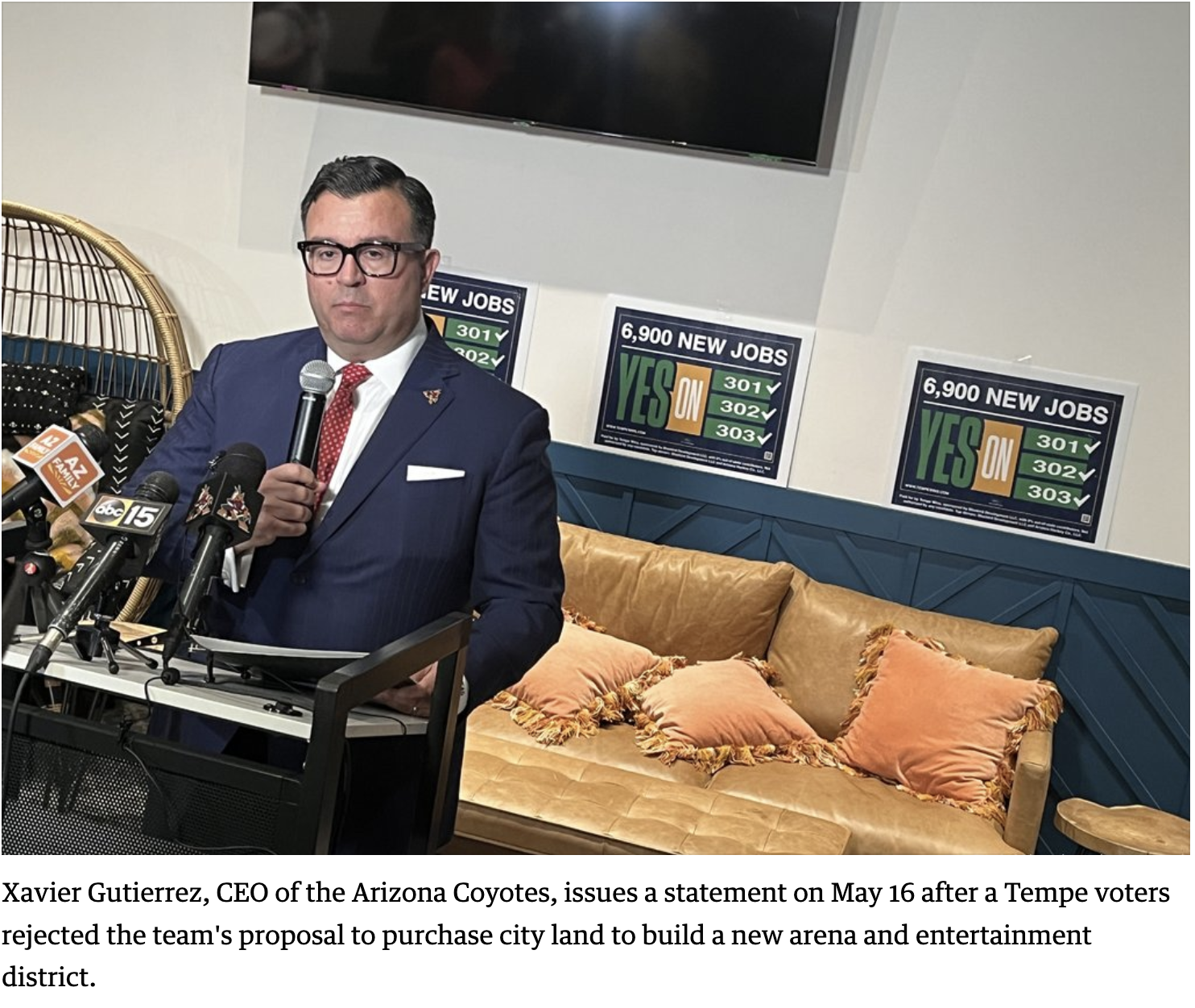
Coyotes CEO Xavier Gutierrez was not in attendance at the party when the results were unveiled, but came to address news media and team supporters. Gutierrez issued a terse statement and declined to answer questions before leaving.
“We are very disappointed Tempe voters did not approve Propositions 301, 302, and 303. As Tempe Mayor Corey Woods said, it was the best sports deal in Arizona history. The Coyotes wish to thank everyone who supported our efforts and voted yes. So many community leaders stepped up and became our advocates and for that, we are truly grateful. We also wish to thank the countless volunteers who worked so hard to try and make the Tempe Entertainment District a reality and the Tempe City Council for their support as well. While we wanted a different outcome, we remain grateful to all those who volunteered their time and talent. What is next for the franchise will be evaluated by our owners and the National Hockey League over the coming weeks.”
As Gutierrez left, most of the crowd followed.
With the ballots cast in Tuesday's special election, the Coyotes hit a huge roadblock in the team's plans to find a full-time home and put to an end years of speculation on the team's future.
The vote for three propositions, which would have changed the classification of land from 46 acres of city-owned commercially zoned property into a mixed-use project, was the final hurdle for the $2.3 billion project to move ahead. The project is located at the northeast corner of Priest Drive and Rio Salado Parkway.
The early vote totals from Tuesday night: Proposition 301: 56% No, 44% Yes; Proposition 302: 56% No, 44% Yes; Proposition 303: 57% No, 43% Yes. None of the in-person voting has been counted yet and is expected to be released on Wednesday.
A total of 29,153 votes were cast in the special election as of early Tuesday night, a vastly higher total than the amount of votes cast in a Tempe City Council election held in March.
In a statement posted on the NHL's website, Commissioner Gary Bettman said he would meet with Coyotes' majority owner Alex Meruelo to discuss the team's future.
"The National Hockey League is terribly disappointed by the results of the public referendum regarding the Coyotes' arena project in Tempe," Bettman said in his statement. "We are going to review with the Coyotes what the options might be going forward."
Tempe had approved the development last November, but the Coyotes decided to give voters the final say.
The 46 acres for the Coyotes' proposed arena are currently being used as a city landfill. The project was to be anchored by a 16,000-seat arena for the Coyotes, other elements of the mixed-use project include hotels, restaurants, offices, and nearly 2,000 apartment units.
The project had pushback from other entities, including the city of Phoenix and Phoenix Sky Harbor International Airport.
On April 5, the Coyotes filed claims with the Arizona Superior Court asking to intervene in Phoenix’s suit against Tempe. The team also filed a motion to dismiss the city's suit, claiming it violated state law by interfering with an election.
NHL commissioner had backed the deal
Worker Power, a local nonprofit that worked to get out the vote for those opposed to the project, issued a statement after the preliminary results were released.
“Since we started, our message has been that voters care about how their city grows and whether it does so in a responsible way. We advocated for transparency and more opportunities for community input,” said Brendan Walsh, Executive Director of Worker Power. “The city rushed the entire process. Our recourse was to refer the project to voters and thereby offer the chance for voters to weigh-in in a meaningful way on an issue they just demonstrated they care deeply about.”
Grassroots opposition to the Coyotes Arena deal centered around the massive tax breaks in the form of Government Property Lease Excise Tax (GPLET) abatements. The GPLET tax abatement program is used to spur development in Arizona’s major cities. However, Worker Power and other opponents pushed the idea that tax breaks can add up to millions of potential dollars not spent on local schools and other community needs over time.
Playing in their first season at the newly christened Mullett Arena on the Arizona State University campus in Tempe, the Coyotes completed their 2022-23 campaign with a record of 28-40-14 regular season, with full attendance of 4,500 per game, the smallest arena capacity in the NHL.
Meruelo had agreed to invest $20 million to upgrade Mullett Arena's dressing rooms to NHL standards with the hopes that the new arena would be built in about three years.
Bluebird Development LLC, the development arm of Meruelo’s company that was working on the Coyotes project, had donated nearly $500,000 to Tempe Wins, the political action committee backing the 'Yes' vote campaign, during the past six months.
Bettman had a huge stake in the proposed project, making two trips to Arizona in the past 12 months to show support for the arena development.
With the possibility that the team could be sold or moved to a new city now part of the conversation, several U.S. markets — Houston, Atlanta, Kansas City —, as well as Hamilton and Quebec City in Canada, have long expressed an interest in landing an NHL franchise. Kansas City, Atlanta, and Quebec City previously had NHL franchises.