Published August 21, 2023
A NEW BUSINESS PIPELINE WHY PHOENIX WANTS TO PUT THE FAST-GROWING VILLAGE OF LAVEEN, POPULATON 65,000, ON THE REGION'S ECONOMIC DEVELOPMENT MAP

A New Business Pipeline
Why Phoenix Wants To Put The Fast-Growing Village Of Laveen, Populaton 65,000, On The Region's Economic Development Map
Eric Amadio and his wife Christina have owned and operated Amadio Ranch for more than a decade, selling produce, pies, jam and honey in Laveen, a rural and agricultural community that is home to more than 65,000 residents in the southwest part of Phoenix.
Knowing that the Loop 202 freeway would connect the East Valley through Laveen and up to Interstate 10, the couple had spent years marketing their business to other parts of the metro. It finally paid off after the freeway was completed in 2019.
“Once that freeway opened, it really expanded our opportunities because now it’s easy to get here,” Amadio told the Business Journal. “As far as what we do here on the farm it doubled pretty much overnight and has continued to expand, as Laveen isn’t so far out there anymore.”
Before the freeway expansion, Amadio said it could take 45 minutes to drive to and from other parts of the Valley, but now it’s a 10-minute drive to access other area communities.


Similar to some West Valley communities whose growth stalled during the Great Recession, the extension of a major freeway has opened the doors for small businesses and brought dozens of needed amenities. That includes housing — planned years ago — that is now coming to fruition as a result of the new highway infrastructure.
Indeed, one of the biggest signs of the area's maturation is the fact that Phoenix-based Vestar earlier this year announced plans for the Laveen Towne Center, the first outdoor mall in Laveen that will include 400,000 square feet of retail, entertainment and dining options similar to Vestar’s other major projects.
Leveraging Laveen’s growth, Phoenix is using this opportunity to foster economic development in the area by creating the South Mountain Technology Corridor around the Loop 202 for advanced manufacturing, with the goal of bringing quality jobs to the growing labor pool as semiconductors, electric vehicles and battery industries boom in Arizona. At full build-out, the new corridor could see 8 million square feet of new industrial space along the freeway.
For more on how Phoenix has become the "it girl" for economic development, check out this report from Audrey Jensen.
While this could change Laveen’s small-town bedroom feel and reduce farming, residents say that technology jobs are needed to further increase wages, expand the existing employment base and keep workers in the community. Nonetheless, with limited existing infrastructure, market changes and strong demand for distribution and logistics in the Valley, real estate experts say the city could face an uphill battle in creating a technology corridor without allowing more traditional industrial operators to also open facilities in the area.
After plans stalled, Laveen growth boomed
For years, area residents have looked to Laveen for cheaper homes close to downtown Phoenix, but the 30-square-mile community has lacked amenities, such as retail, due to the pause on homebuilding after the housing crash and the lack of freeway access.
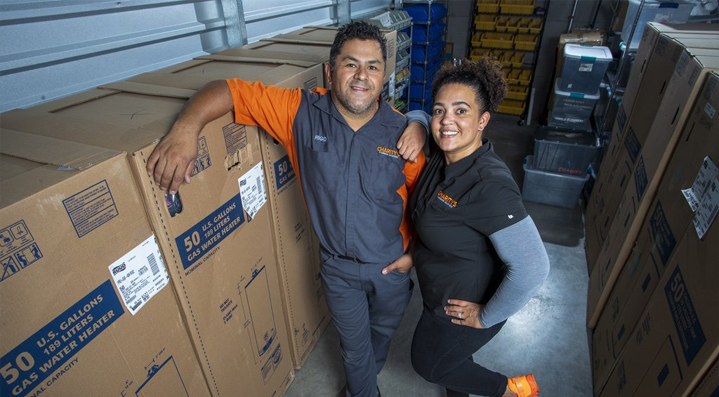
Home affordability was on Charity Tovar's mind when she moved to Laveen in 2004. The owner of Charity’s Plumbing Solutions was also anticipating planned commercial development such as a proposed 40-acre village core with retail, office and housing along Dobbins Road — that was never built.
“Back then there still was not a grocery store in Laveen,” she said. “There was major planning back in 2007, before the economic crash, which basically was put off for almost 15 years.”

Tovar said she stayed in Laveen for her kids and because the village became her community. She started her own residential plumbing business this year with her husband, Rigo Tovar, to serve the growing population and joined an effort by local businesses to address fentanyl addiction challenges in the community. Laveen had about 20,000 homes in 2020, nearly 10 times the 2,500 units back in 2000, according to Maricopa Association of Governments data.
Jacque Alvarado, a realtor with JC Realty in Laveen, said homebuilders picked up construction again in the area in 2012, and by the time the Loop 202 had been built out, the growth sent home values higher.
The median house price in the Laveen ZIP code 85339 was $499,000 this summer, 20% to 30% higher than several years prior, Alvarado said.
The area has also recently passed the $90,000 average household income level and had an additional 3,600 single-family homes and 2,700 multifamily units underway in August, all of which has helped attract retailers to the undeveloped land around the Loop 202, according to the city.
Vestar's Laveen Towne Center is just one of the new projects popping up to support the residential growth.
Also on the way is the 65-acre mixed-use Laveen Spectrum and a new Harkins Theatre complex as well as a proposed 36-acre Banner Health Laveen Medical Center along the freeway and Baseline Road.
Why Phoenix wants to put Laveen on the map
Several planned mixed-use projects with new stores and restaurants will bring hundreds of jobs to Laveen residents, but high-wage employment is still lacking.
Right now, some of the largest employers in the west Phoenix village are school districts, retailers and construction companies. The Laveen area had nearly 500 employers totaling nearly 8,000 jobs as of 2021, with about 20% of those jobs in the education industry, according to MAG's employer database.
“We don’t really have very many high-level jobs here, we didn’t have a hospital in the recession but now we have a small Dignity Health,” said Linda Abegg, the Laveen Village Planning Committee chair. “There’s very little in the way of medical or technology.”

Mapcreator
To help diversify the jobs in the area, Phoenix has been working to put Laveen on the radar of major tech companies by marketing and zoning several hundred acres for industrial development along the Loop 202 — one of the few mega sites within the city that could accommodate a major user with utilities.
“This is an ideal place for advanced manufacturing, not for logistics and distribution,” said Nathan Wright, deputy director of community and economic development for Phoenix. “This is some of the last area on a freeway that has this much infrastructure around it.”
Wright said this spot is ideal for tech companies because of its location related to the West and East Valley, noting that about 65% of West Valley workers travel east for work. It can also benefit from utilities such as the nearby 91st Avenue Wastewater Treatment Plant, one of the largest in the southwest, Wright said, adding that they're working on expanding power in the area.
The Loop 202 corridor is also located close to Intel Corp. and the Price Road corridor in Chandler and has access to the Taiwan Semiconductor Manufacturing Co. in north Phoenix through the Loop 101. Wright said facilities such as a major Amazon warehouse will not be located here.
“This was kind of a back-up site for TSMC when they were first looking at sites,” Wright said. “It’s ideal for those types of companies that need big infrastructure and a highly-skilled workforce.”

The city said the sites around the Loop 202 have been shortlisted for a couple of “mega projects” representing more than $1 billion and more than 1,000 jobs each as well as for companies in the solar, semiconductor, electric vehicle and battery industries, but no announcements have been made.
What's next for South Mountain Technology Corridor
Much of the remaining infill land around the Loop 202 has been built out with warehouses a few miles north of Laveen, which means the prime industrial sites in the area are now further south in Phoenix's new tech corridor, which is centrally located between other major industrial submarkets.
"The Laveen area has become, with the completion of the 202 freeway, a really viable residential market, there's a lot of new housing, a lot of really good labor that's right there," said John Werstler, a senior vice president with CBRE Group Inc. "You can be an industrial user and not necessarily have to compete for labor."
Developers including Scannell Properties, IDM Cos. and Leon Capital Group are planning to build out nearly 500 acres of industrial mostly west of the Loop 202. The city has agreed to reimburse the three companies tens of millions of dollars overall for public infrastructure in the area to support projects such as Leon Capital's Group's Freeway Commerce Park@202, which could accommodate several large industrial buildings across 82 acres with Loop 202 frontage.

CBRE GROUP INC.
Scott Moe, director of development for Scannell Properties, sees Laveen as the next big thing. He's been working with the city for a few years to plan the 240-acre Dove Ranch 202 Business Center and the infrastructure to support it, which will represent a more than $300 million investment and total about 3.7 million square feet.
"As a developer you're always looking for the next wave, where's the development headed? It just appeared to us that it had to come that direction," Moe said. "It really has to do with land availability and affordability."
First user plans build-to-suit facility for Loop 202 corridor
Moe said the city's economic development team has been working aggressively to market to technology-related companies but said it hasn't happened yet because the site is still undeveloped land without existing buildings to show.
Although not the type of high-profile company the city was hoping for, the first user that will locate within Dove Ranch is Performance Food Group, which will occupy a 131,500-square-foot light manufacturing and food assembly center in a build-to-suit project.
"We're breaking ground on the road improvements and the utility installation this week, so in about three months this thing's going to start to look a whole lot more like a business park than it does today," Moe said in July. "It's very hard to attract companies when it's nothing but raw desert land."
Other traditional users such as custom cabinet makers and product distributors have also been asking about the area but only a limited number of sites allow for these types of uses. Moe said it will be difficult to develop out the entire area with only tech companies.
Data center users have considered Laveen as well but can't currently locate there because of latency requirements, said Josh Wyss, an executive director with Cushman & Wakefield.
"It's really a clever location for distribution and it's unfortunate that you can't do it there because it's a great point to serve the entire Valley without being stuck in the congestion and high pricing you have right near Sky Harbor Airport," Wyss said. "Anything that's going to be considered advanced manufacturing is going to need heavy connectivity."
Werstler, who is handling leasing for Leon Capital's project in Laveen, said he expects the new corridor to be developed in similar fashion as the Phoenix-Mesa Gateway Airport corridor along the Loop 202 in Mesa, albeit on a smaller scale.
"There's some infrastructure that has to be completed, so they'll need to upgrade the water, sewer, all of the off-site infrastructure needs to be completed," Werstler said. "But once that's completed then you'll have a lot of land that will be able to be developed."